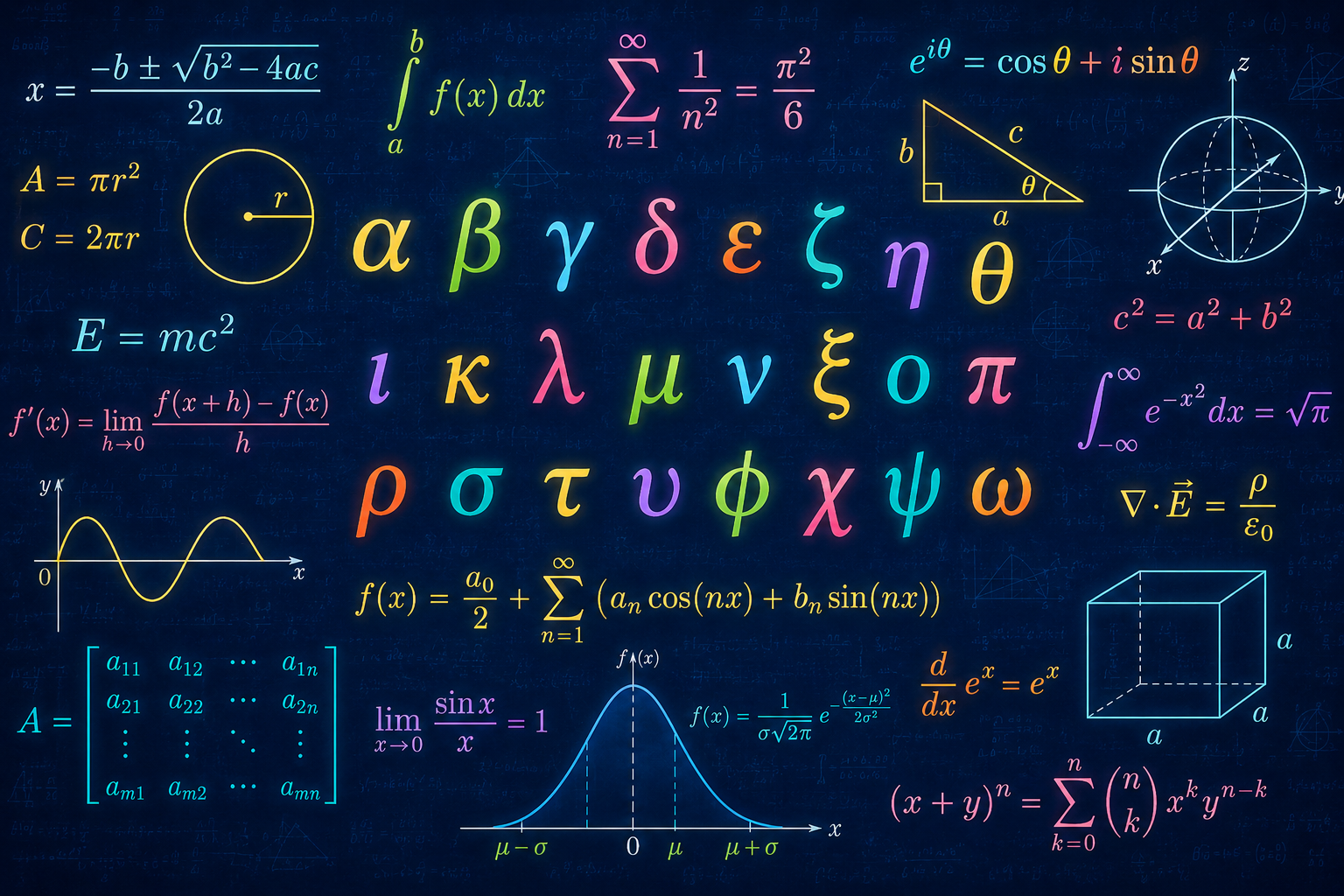
The Greek Alphabet in Mathematics: A Symbol-by-Symbol Guide
Greek letters show up everywhere in mathematics, physics, statistics, engineering, and computer science. Some letters have standard meanings, while others vary by field or even by author. The table below lists the Greek alphabet, followed by a practical guide to how each symbol is commonly used in math.
Greek Alphabet Reference Table
| Name | Uppercase | Lowercase | Common mathematical uses |
|---|---|---|---|
| Alpha | Α | α | Angles, constants, coefficients, significance level |
| Beta | Β | β | Coefficients, angles, beta functions, regression parameters |
| Gamma | Γ | γ | Gamma function, constants, curves, angles |
| Delta | Δ | δ | Change, difference, small variation |
| Epsilon | Ε | ε | Small positive quantity, error tolerance |
| Zeta | Ζ | ζ | Riemann zeta function, special functions |
| Eta | Η | η | Efficiency, learning rate, coordinates |
| Theta | Θ | θ | Angles, polar coordinates, parameters |
| Iota | Ι | ι | Rare in math; sometimes indexing or inclusion maps |
| Kappa | Κ | κ | Curvature, condition number, cardinality |
| Lambda | Λ | λ | Eigenvalues, wavelengths, parameters |
| Mu | Μ | μ | Mean, measure, coefficient, micro prefix |
| Nu | Ν | ν | Degrees of freedom, frequency, sequences |
| Xi | Ξ | ξ | Random variables, coordinates, special functions |
| Omicron | Ο | ο | Rare; lowercase resembles Latin “o” |
| Pi | Π | π | Product notation, circle constant |
| Rho | Ρ | ρ | Density, correlation, polar radius |
| Sigma | Σ | σ | Summation, standard deviation |
| Tau | Τ | τ | Time constants, topology, torque-like notation |
| Upsilon | Υ | υ | Rare; sometimes variables or special functions |
| Phi | Φ | φ / ϕ | Angles, golden ratio, fields, normal CDF |
| Chi | Χ | χ | Chi-square distributions, characters |
| Psi | Ψ | ψ | Wave functions, functions, angles |
| Omega | Ω | ω | Sample space, angular frequency, limits |
Alpha: Α, α
Alpha is often used for angles, coefficients, or constants. In statistics, α commonly represents the significance level of a hypothesis test, such as 0.05. In algebra or calculus, it may simply be a parameter whose value is fixed but unspecified.
Beta: Β, β
Beta frequently represents a coefficient or parameter. In statistics and machine learning, β is commonly used for regression coefficients. In special functions, the beta function is written as B(x, y). Like alpha, beta may also be used for angles.
Gamma: Γ, γ
Uppercase Γ often denotes the gamma function, which extends factorials beyond whole numbers. Lowercase γ may represent a constant, an angle, or Euler’s constant in some contexts. In geometry and analysis, gamma is also often used to name curves or paths.
Delta: Δ, δ
Delta is strongly associated with change. Uppercase Δ usually means a finite change or difference, as in:
Δx = change in xLowercase δ often represents a very small change, variation, or tolerance. In calculus, δ appears in epsilon-delta definitions of limits.
Epsilon: Ε, ε
Epsilon is famous for representing a small positive quantity. In analysis, ε is used in precise definitions of limits, continuity, and convergence. It can also represent error, tolerance, or a small perturbation.
Zeta: Ζ, ζ
Zeta appears most famously in the Riemann zeta function, written as ζ(s). This function is central in number theory, especially in the study of prime numbers.
Eta: Η, η
Eta often represents efficiency in applied mathematics, engineering, and physics. In optimization and machine learning, η is frequently used for a learning rate.
Theta: Θ, θ
Theta is one of the most common symbols for angles. In trigonometry and polar coordinates, θ often represents the angle measured from an axis. In statistics, θ is also commonly used for an unknown parameter.
Iota: Ι, ι
Iota is relatively rare in mathematics because it can be confused with other symbols. When used, it may represent an index, a small quantity, or a specific map in abstract algebra or topology.
Kappa: Κ, κ
Kappa often appears in geometry and linear algebra. It may represent curvature, a condition number, or a cardinal number. In statistics, kappa can also measure agreement between raters.
Lambda: Λ, λ
Lambda is widely used for eigenvalues in linear algebra. If a matrix transforms a vector by stretching it, the stretch factor is often written as λ. Lambda also appears in calculus, optimization, probability, and physics.
Mu: Μ, μ
Mu is commonly used for the mean or expected value of a distribution. In measure theory, μ often denotes a measure. It can also represent coefficients, such as a coefficient of friction, depending on context.
Nu: Ν, ν
Nu is often used for degrees of freedom in statistics. It may also represent frequency, sequences, or indices. Because it resembles the Latin letter “v,” authors sometimes avoid it when ambiguity is possible.
Xi: Ξ, ξ
Xi appears in probability, analysis, and differential equations. Lowercase ξ is often used for random variables, coordinates, or intermediate values. It may also appear in special functions.
Omicron: Ο, ο
Omicron is rarely used in mathematics because it looks almost identical to the Latin letter “O” or lowercase “o.” One important related notation is Big O, as in O(n²), but that is usually the Latin letter O rather than Greek omicron.
Pi: Π, π
Pi is one of the most famous mathematical symbols. Lowercase π represents the circle constant, approximately 3.14159. Uppercase Π is used for product notation, much like Σ is used for summation.
Example:
Π ai = a1 × a2 × a3 × ...Rho: Ρ, ρ
Rho often represents density, correlation, or radius in polar coordinates. In statistics, ρ commonly denotes a population correlation coefficient.
Sigma: Σ, σ
Uppercase Σ represents summation. For example:
Σ ximeans “add up the values of xi.”
Lowercase σ often represents standard deviation, especially in statistics and probability.
Tau: Τ, τ
Tau can represent a time constant, a parameter, or a variable in calculus. Some mathematicians also use τ for the circle constant equal to 2π, though π remains more common.
Upsilon: Υ, υ
Upsilon is not used as often as many other Greek letters. It may appear as a variable, in special functions, or in advanced notation, but it does not have a single dominant mathematical meaning.
Phi: Φ, φ / ϕ
Phi has several important uses. Lowercase φ often represents the golden ratio, approximately 1.618. In number theory, Euler’s totient function is written as φ(n). Uppercase Φ is commonly used for the cumulative distribution function of the standard normal distribution.
Chi: Χ, χ
Chi is best known from the chi-square distribution, written χ². This distribution appears frequently in statistics, especially in hypothesis testing and goodness-of-fit tests.
Psi: Ψ, ψ
Psi often represents functions, especially in physics and applied mathematics. In quantum mechanics, ψ commonly denotes a wave function. In pure math, it can be used for mappings, functions, or special functions.
Omega: Ω, ω
Omega often represents something final, total, or large. In probability, uppercase Ω usually denotes the sample space. In asymptotic notation, Ω describes a lower bound. Lowercase ω is commonly used for angular frequency.
Closing Thoughts
Greek letters are not magic symbols with fixed meanings. Their meaning depends heavily on context. Still, many conventions are so common that recognizing them can make mathematical writing much easier to read. As you move through algebra, calculus, statistics, physics, and advanced mathematics, these symbols become part of the shared language of the field.